All throughout the archipelago,
the faithful members of the Catholic Church join this yearly procession on the
eve of the Lenten triduum, the apex of the Lenten season where the faithful
commemorates the passion and death of Jesus. In Cavinti, however, the town
faces a much more challenging approach in showing their faith. The town’s
streets are all inclined, some of the roads tilting to as much as by 45
degrees. With each “carroza” weighing
as much as your average car, the devotees assigned to push the images all face
the inevitable difficulty of doing their duty.


“Kaya naman, may kahirapan lang pagdating sa may matataas na kalsada”
(I could handle it, It just gets harder when the roads get higher) says one of
the faithful. According to him, he has been doing his duty for years now ever
since he was a kid. The task was much harder in the past, with most of the
roads extremely damaged by constant use by vehicles, motorized and
animal-drawn, passing between the farms to the markets in the nearby lowland
cities of Quezon and Laguna.


The whole procession passes
through most of the town. After the hour-long procession, owners of the images
generously give the people food and water after the ceremony, a simple reward
for their hardship. Owners of the images have taken care of their respective
images for centuries, as a form of thanksgiving and a sign of devotion. In some
cases, the images have been passed on from generation to generation, a family
tradition of taking care of the images much like how some families take care of
heirlooms. Thievery, however, has started to become a problem with some families.
Much like in olden times, these family images depicting scenes from the Bible are
also made wear finery and jewels that are considered to be priceless as a sort
of show of gratitude for favors received. One certain image, the Nazareno (Nazarene), an image depicting
Christ carrying the cross, used to wear a crown of thorns made of silver. As
the owner recounts, the crown was stolen after a procession, much to the anger
of the caretakers who have always taken much care of their heirloom. A crown of
thorns fashioned from barbed wire was all the image could don for the Wednesday
procession.
A hundred kilometers away or so
from the town of Cavinti, another town sets the stage for the Lenten Triduum.

One of the mother towns of
Tayabas (now Quezon), Gumaca is one of the oldest settlements in the region,
even in the entire country as some people suggest, having been a proper
settlement even before the arrival of Spanish conquistadors. A good distance
from the metropolis, the town serves as a gateway to Bicolandia. Once a walled
town like its sister, Intramuros, the town still holds mementos of its days as
part of the empire of the Spain; the kastilyo
(castle), acannon-armed fortress facing Lamon Bay reminiscent of days when
pirates still threatened the coastal towns of the Philippines. What was once a massive
wall that sealed off the town from the outside has now since been leveled,
serving its current purpose as a promenade where people could ride bikes and
cool off under the shade of the trees.


A short walk from the Kastilyo sits the Cathedral of San Diego
de Alcala, the seat of the Diocese of Gumaca. There, against the backdrop of
the Narra trees and the walls made of coral, images ready for the Good Friday
procession wear their best attires for the evening, in contrast with the solemn
black dress of Mary grieving her son’s death on the cross. Like a funeral itself
attended by the whole town in the silence of the twilight, accompanied by sung
prayers and the music of a violin, people walk alongside the glass coffin of
the dead Christ as he is sent off to His final resting place, the Church,
waiting for His time to reign triumphant once more.Some choose to stay,
however, to spend the night sing the Pabasa,
a book sung like a hymn. The Pabasa
tells of the Bible story, from Adam and
the Garden of Eden culminating with Jesus’ Passion, Death, and Resurrection.


The sad tone of the evening of
Good Friday gives way to the joyous songs of the midnight of Easter Sunday.
What starts with a procession
ends with a procession. With only candles as their light in the dead darkness
of the night, the faithful, each separated to their respective groups, walk
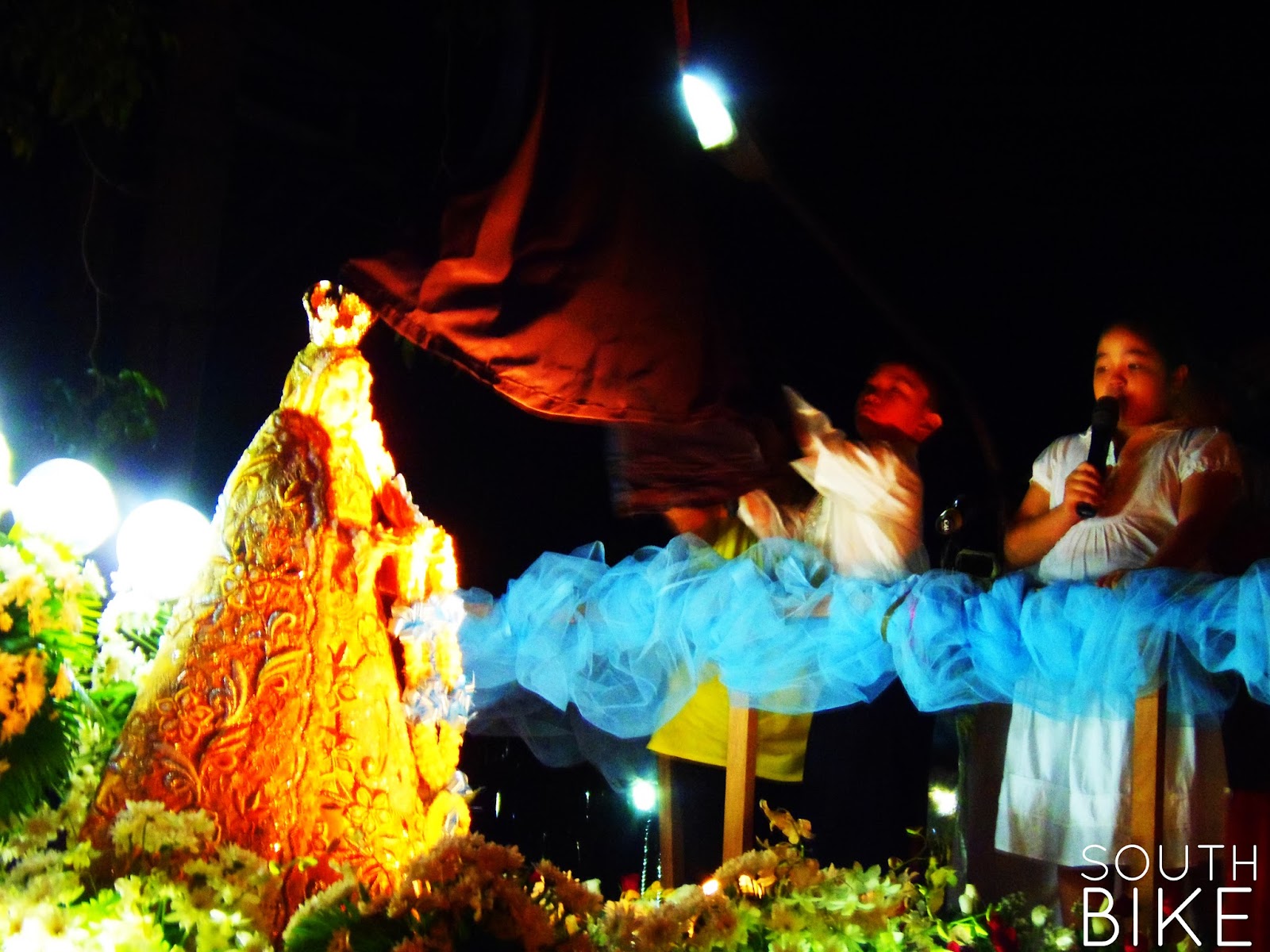
together in the century-old practice of the Salubong. The womenfolk join the
image of Mary as she rounds the town in her mourning veil. Gleeful in white,
children dressed in white and wearing wings sing about Mary as they remove her
veil, rejoicing over Mary meeting her resurrected Son.


The processions of old are now
echoed in the streets by cars. Along with the rush of devotees coming to local
pilgrimage sites such as the Kamay ni
Hesus (Hand of Jesus) shrine comes the exodus of the people from the
metropolis, back to return to their homes or to retreat to the beaches far
south – and back to the cities as Monday approaches once more.
For some, the ancient wooden and
ivory statues serve as a link, human to the divine, to others a reminder of a
simpler time, when houses of old lined up the streets, lit up by candles and
torches as the procession passes by – of times long gone when the sound of the
church bells commanded the pattern of the day to day life, a time of
processions.